The Prostituted Asian Massage Parlors: Don’t look, don’t listen, don’t tell.

She’s just a girl.

Not too different from you and I.

Or your daughter, or your mother, or your sister, or your niece, or your granddaughter.

Well, there are slight differences, but nothing so significant that separates her humanness from that of our own women.

For starters, she’s from China. And some places in China, and many people in China, do not have the same access to opportunity that we have in America. The same money, jobs, loans, protection, freedom. It’s just not the same, and we have to start there because we often judge this girl as if she made her decisions having had our own lives and opportunities. She didn’t. She had a different life.

It’s not that one life is better than another. It’s simply different.

She has a family, perhaps a job, often education, dreams, talents, aspirations, and, above all, dignity.

There may come a point of crisis, or need, or dream, to provide more for her family, or for herself — to earn more income, to have more opportunities and achievements. Not every economy has a “career path.” She goes only to work in a clothing factory from sunrise to sunset and walks away every month with maybe $200. Not enough to live on. And definitely not enough to live up to her aspirations — perhaps as a doctor, or accountant, or fashion designer.

When you live on the edge of survival you can’t afford the luxury of dreaming.

But she hears about a job, and it looks like a pretty good job. Doing hospitality work for an upscale restaurant or 5 star hotel. And the pay would start at $2000. $2000 a month! That’s 10 times what she makes how! Imagine if she did that for just 2 years — she could save up so much to pursue a real education and career path in the land of opportunity. Which, of course, is America.

The land of the free, the home of the brave.

So she makes the incredibly difficult and courageous decision to leave what’s familiar in hopes for a better future. She finishes the job search online, as we all do these days, deciding between job postings, applying to some, having phone interviews, video interviews, job offers, and then even learning that the future employer may offer to cover travel costs and even costs of a visa to get to America.

She leaves.

She arrives.

And what she thought was a decision to move into the free pursuit of happiness turns into a living nightmare.

She has just walked into the sophisticated network of international human trafficking.

When she arrives, her papers are taken, she is moved to certain spots and areas, often not knowing where she is. Her entry level job, which may have been high end domestic work, a restaurant manager, or hotel housekeeper, is actually now one of hundreds of Asian spas in Chicago.
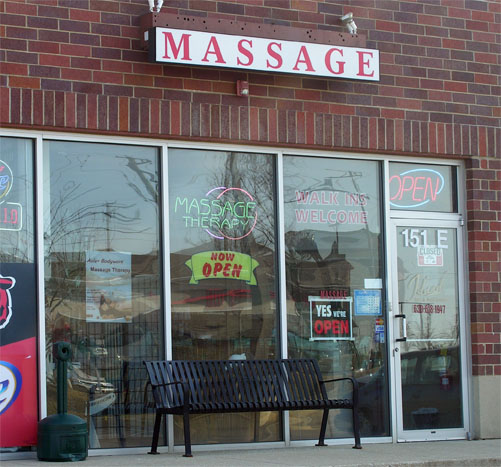
massage

And it’s no typical massage job. This one she finds she must perform sexual services as her job requirement.

What she ended up in was a front for prostitution.

But — but she’s only 19. She came here to grow and give and learn and excel.

This though — this is not what she came for. But now she’s lost and vulnerable — someone else is controlling her: her money, her security, her housing, her information, her everything. This may include physical beatings and rape as a way to “breaking her in” so that she knows who’s boss. Not enough customers coming in? Using her to create online porn is a solution. Gotta make money somehow off her. Resisting isn’t really an option, because her owner controls her money, food, and security.

Nobody would come looking for her if she went missing.

Of course she wants to escape — there’s no way America could really endorse this behavior. But there’s cameras everywhere in the spa, she can’t communicate herself or learn her rights because she is not given the chance to learn the language, she knows the police won’t help because illegal immigrants are not offered the same kind of protections and representation as citizens, and, quite frankly, no one knows and no one really cares about the immigrant prostitutes.

It’s the most overlooked square footage in our city. They’re poor, they’re foreign and they’re women.

She hopes that she can get out quickly, maybe just bide some time before getting enough money to move back to China. Her owner says she needs to work to, “pay of the debt you owe me from me bringing you here.”

But 1 day turns into a week, and 1 week into a month, and 1 month into a year.

And now it’s 14 years later. She’s 33.

“What do you want to do with your life? What’s your dreams?” I ask her this past Sunday while on outreach at her spa in my neighborhood.

She looked back at us with an empty stare.

“No dreams. There’s nothing I want anymore.”

We were all quiet as we let that admission settle into the air.

That was it. No hiding, no putting up a front to keep herself protected, protected from wanting something too much and not ever receiving it.

Her brokenness was real and we all felt the weight of it.

It all feels a little hopeless. An emotion a little too familiar, a little too acceptable.

I mean, she can’t speak English very well despite living here for 14 years, she hasn’t had a day off in a long while, and it looks like her desire is dried up.

But dried up flowers are pretty too.

They’re a little more fragile than full bloom flowers, but they’re not gone, and they’re definitely not useless.

I sit here wondering now if perhaps at some point Sonya* prayed to God, a God she doesn’t yet fully know, and asked for help. I wonder if one of her many desperate prayers was that he’d send some sort of relief and and freedom, giving her a chance to rekindle the fire of lost dreams.

I wonder if we just walked into an answered prayer.

I wonder if we just participated in a miracle, a 14 year-long dried, weary prayer.

I think 2 thoughts: first, that what an honor to be the carriers of light and hope, to be an answer by participating in others’ miracles.

And second, does not God also hear the prayers of his own children, of us, of me, and already has an action plan all set up for our help and deliverance and good? Do we not have our own miracles to walk into?


Though this story I piece-worked together isn’t solely Sonya’s, it’s a mix of a myriad of stories, articles and research told about immigrant trafficking and the Asian massage parlor facades. It’s such a complex, wholly difficult world to understand, mostly because there’s so much silence around it, from both those within and those of us without.

Though that conversation with her on Sunday may have been a difficult thing to hear, we were actually celebrating. Most conversations are superficial as it takes a long time to build trust and hear more of their story. Sonya in particular had been very distant and even at times hostile. But this time was different – she was open, kind, conversational, and allowed a deeper conversation than we’ve had with her previously.

We don’t always pray in person with the women, but this time we felt led and she welcomed us to pray with her in a circle, arms around each other. It was very simple, but so powerful. Her countenance was so different this time and she couldn’t stop thanking us and expressing gratitude. We were seriously ecstatic with praise for this breakthrough!

And her story is just one of thousands of those quiet and hidden Asian immigrants among us.

Be aware that these massage parlors exist not just in the Chicago city proper, or in any major city in America. Actually, of all the teams in Chicagoland, Napperville, a somewhat wealthy west suburb, has some of the most notorious parlors. Our teams are met by managers and bouncers at the doors who won’t even let them speak to the women. There are cameras outside the building as well as inside. Often the women work and live inside that building, never allowed to leave, and may not even know what state they’re in. To make sure they aren’t tracked, owners will move girls from parlor to parlor which are a part of a larger network of international trafficking and crime. They are very dark places.

However, that doesn’t deter New Name. We are a group of loved ones telling these women that they are loved, seen and heard. We don’t know their stories, how they got to that spa, and all the obstacles they have faced. But we know that if we are loved and forgiven, we have every right and place in the world to offer that to them.

New name home page

We have teams all over the Chicagoland, from Wheaton to North Shore to all the way in the city, and we go into the spas bearing gifts and offering friendship.

We also live and breathe prayer. If there isn’t prayer, nothing happens. There is no hope, protection, or relief without God’s intervention.

Yes, not all massage parlors and Asian spas are fronts of prostitution. But we target our spas based off of online research where Johns (those who purchase sex) will review their experience with the businesses and the women. The reviews are explicit and include checklists of their masseuse’s body and how they would rate their performance. Johns use these reviews to decide the best places to go with the kind of woman they want for the right price.

But we believe there is hope and freedom in this industry, for the survivors, the Johns, and the traffickers. All are offered a place to the table of Jesus.

Here’s what we don’t do: We are not rescuers. We believe that each person has an infinite amount of dignity, worth, and value. They are intelligent, capable, smart, and have had to learn how to survive in ways that many of us will never have to. It’s incredible. We have much to learn from them.

We have no agenda but to love.

New Name also reaches out to all women in the adult industry which includes women at strip clubs and prostitutes posting services online. We do call centers and follow-up in order to help each individual take the next step in life.

Often, when a women decides that she wants out, there is an immediate need for a safe place before moving her into a longterm aftercare facility. Often these are trafficked victims. Since safety is the first priority, we have created an initiative called the Safer Place.

Our Safer Place Initiative quickly transitions a woman out of the adult industry to a safe place until we are able to get her to a long-term care or healing facility. We started the Safer Place because we were meeting with women who were interested in getting out but were discouraged by their boyfriend, pimp or even family members from going into a restorative program. We’ve found that when we take a woman a significant distance away from where she’s been working, she is able to have the separation she needs from her environment and can take some deep breaths, relax and process her decisions.

So get this: It’s my birthday today and I unashamedly admit my exceeding jubilance for birthday food (hot fudge brownie sundae, anyone?), as well as celebrating with good friends with some serious swing dancing tonight. And I may have a Stitch Fix box waiting for me downstairs — gah, happy birthday to ME!

But what would be the most incredible gift is to see our new Safer Place be completely prepared for the welcome of our first woman. One of our team leaders has renovated her and her family’s home to offer our first Safer Place.

Check out the Amazon wish list where there’s a list of items that are still needed to furnish the home. Could you participate in another woman’s answer to prayer, participating in her miracle?

It’s beyond totally worth it.


*Sonya is her pseudonym 
Brokenness is the secret sauce of compassion

I never quite understood why I am the one doing the things I’m doing.

Yes, I’m typically secretly insecure, conveniently hiding under a layer of, “Of course I can do this and it makes sense and why not? Don’t challenge me.”

More often than not I’ve just tried to ignore and be louder than the suspicious soul voices: “Really? You’re hanging out with homeless guys, prostituted women, survivors of trafficking, recovering addicts, and abused children? Are you serious? You have no idea what they’ve gone through. You’re only naive and condescending. Who do you think you are, some sort of ‘help’?”

Yeah, it’s a slippery slope. Once you begin basing your value on your experiences, those thoughts will remove you from giving and will eventually descend into every other relationship and friendship until one day you’ve completely talked yourself out of being worth anything to anyone.

I’ve fought against giving in to it. Over and over. I didn’t always know why, though. But something in me knew that if I didn’t want others to judge me based on my externals than I couldn’t ever let that filter exist in my life.

But recently I’ve realized that the connection which leads to my compassion comes from a place where shared experiences are completely unnecessary.

If compassion comes from connection, where did that connection come from?

I’ve tried to figure out where everything changed and I started having deeper connection. I had a major spiritual encounter about 5 years ago that challenged my little world and narrow perspective. I knew at that point that I would be seeking out broken people, as I then called them.

Soon enough it wasn’t me going to them anymore; it was them coming to me. Or “random” encounters. Or perhaps just the law of attraction?

At this point it turned into something different, something unexpected. Though I had grown up in churches that did ministries for broken people, it literally offended me when my pastor once asked me, “So how’s your ministry going?” and another couple saying, “You must be really courageous.” I didn’t know why I wanted to react, but part of me wanted to retort, “It’s good – how’s your ministry going?” and “So why aren’t you courageous?” and “This isn’t my ministry; it’s my life and I’m simply friends with the people in my life who happen to be different from me. Why is that a special ministry??”

But I never said that because, obviously, it seemed a little unfair to some well-meaning people. And in its own vein self-righteous.

Yet I still couldn’t figure out why others saw my life as unusual or courageous when I particularly didn’t.

In the past 5 years my friend group has included homeless men and homeschooled guys. Drunks and preachers. Business owners and drug addicts. Strippers and homosexuals. Prostitutes and counsellors. Immigrants and high-end escorts. Missionaries and convicts. Muslims and foreigners. A lot of them I opened my home to or just shared life in general with them.

But I seriously cringe when I just list off categories like that, that somehow we can encapsulate an entire person into one singular label. We are not defined by our life season, our country, our societal culture, or our past record.

Additionally, we are never defined by our worst day or worst choice or worst circumstance.

So when others question my choices, or I question myself, I go back to where it began for me, which was something like, “Wow, you are the kind of person I would like to get to know,” and then as time developed with certain people, specific areas of brokenness surfaced, and that naturally led to opportunities to share life and help out as needed.

Some of those issues became trends. And I found those trends already had a name: social justice.

Then I realized why the so-called “broken culture” was especially drawing to me.

It’s not because they have some extreme external circumstance and it’s “shocking” and I want in on that so I can use their stories to make my life more interesting.

No, that would actually be exploitation of another face.

What I found instead was a common brokenness.

And broken people are attracted to broken people.

It long stopped being “they are broken” and it became “we are broken.”

For so long in my life I didn’t allow myself to be broken because I was ashamed of any internal brokenness or weakness, and for me not being strong was the most vulnerable and threatening place to be (and yes, still is).  So I created a really safe, protected life that never challenged my strength, which was, ironically, my greatest weakness. I was so afraid of being ashamed, of being vulnerable, that I created walls that kept me safe and everyone else out. It worked out pretty well for a long time.

That wall started to crumble when I went through my own depression and rejection which led me to actually feel and process emotions, and that experience caused me to recognize others with those same emotions around me. It’s like I had this new rejection radar and I’d see someone and be like, “You got it too!”

This wasn’t about me fixing them. But it was about us sharing something.

And that’s all, folks.

We don’t need to look for shared experiences or commonalities to find connection. We can simply look for shared brokenness, which is actually shared humanity.

And sharing brokenness transcends all barriers: societal, cultural, denominational, racial… all of that other stuff falls below the reality that we are sharing something much bigger, something much stronger than just “we look alike, believe the same thing, have a similar past, have the same struggles, and grew up in the same place.”

People are not projects and each one has incredible dignity, no matter how much their lives don’t make sense to us.

I’m finding that the ones that have the hardest time relating to others vastly different from themselves are the ones who won’t allow themselves to be broken. Oh, we all have it. It’s all there. It’s just that some people have had to deal with it in the wide open (your “societal broken” ones), and some have then allowed the struggle to make them stronger while still embracing the weakness of their continual brokenness.

Others, however, perhaps never had to fight external pressures and live on the edge of survival. Like me for so long, it created this false sense of self-reliance, that I can do anything, that I can fix myself, that there’s not really much wrong with me, that I’m above the struggle, and everyone needs to settle down about “justice” issues all around us.

Because when we have no awareness of our brokenness, we have no capacity for caring. Our compassion is only as deep as our brokenness.

And brokenness is the secret sauce of compassion.

Brokenness

A friend asked me not too long ago, “How do you get to the place of really caring about people, especially people who have hard lives I really don’t and can’t understand?” It kind of surprised me, though I appreciated her honestly, and I stumbled for words. “I guess, you know, uh, you just have to go through it. Just like they are. Like, you gotta feel that pain, the same kind they feel.”

It took some pretty difficult experiences for me to recognize my own brokenness, but now I wouldn’t change it for the world. I feel like I’ve never felt before. Don’t get me wrong – it’s often not really good, like, I don’t sit around thinking, “Boy, this anguish is incredible. Two. Thumbs. UP!”

No, I just feel things really deeply. And sometimes I do something about it, but sometimes it’s just real to feel. To know that some place inside of me still cares, even if it’s anger and bitterness or hope and joy. It’s all part of the process of letting go of strong-enough and embracing the this-burns-right-now brokenness.

At first I thought this post would be about social justice and not trying to create narratives that certain broken lives mean more than other broken lives, that just because we don’t understand someone’s brokenness doesn’t mean that we can withhold mercy.

But … maybe this is a word about that.

Maybe we can’t separate a fight for justice from the hand of mercy coming from a broken heart of compassion.

Maybe what we need is a lot more of is just mercy.

Where’s your brokenness?

If you can’t find it, then you may just be unaware of it. And you may want to investigate reactions of anger, wanting to control conversations, make sure you are right, and a desire to “do away” with certain people and causes (holla at your girl – been there, done that).

Stepping back and opening up like that will do scary things to you. But soon the things you were so scared of will be forgotten in light of the wonderful people you connect with, people who, by all societal means, you should not be spending your time with. Fear will assault you, as you will hear lingering voices, “Who do you think you are for thinking you have anything to contribute to this person?” Believe me, I live with those voices. But it takes a humble attitude of being needy and broken each day to make it through.

Look for those uncomfortable places. For me it’s been connecting with people and cultures that are way outside of my “experience” realm. I can’t say that I “get it” but I can say I know how it feels to be human (broken), so I can share life with them and feel deeply with them and about them.

When you’re at that place, you’ll be moved to do things most people won’t understand. But that’s OK. I dare you to love too deeply, risk too extravagantly, give too recklessly, and feel too much. It may not be a path that is clear and you may be afraid of what people will think, but the reward is fully alive and well worth each investment.

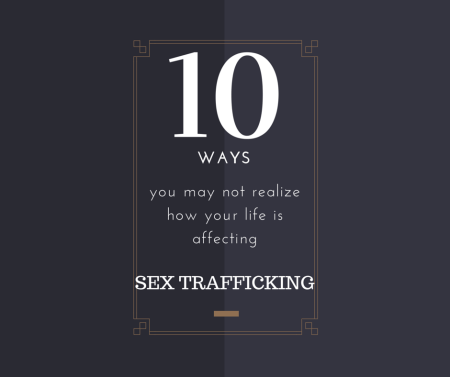
10 ways you may not realize how your life is affecting sex trafficking

Exactly 5 years ago I began down a path of connecting with people who I thought were vastly different from me. This began with those who were in drug addiction, then those who were homeless, then those in prostitution, then those in domestic violence, and eventually those in human trafficking.

You know what happened as I met them?

It stopped being “them.”

And it became “us.”

First, I found that many of my own hurts and wounds were very emotionally similar to those in the “broken” culture. Hey guess what? I’m just as broken! And I think we’re all there– we just have various ways of coping or covering shame.

Second, the economics of my life choices became increasingly obvious. You see, I realized, as in Economics class, that making one choice is a choice for something and a choice against something else. All of our choices and actions and voices and thoughts affect those around us. We affect our culture by the choices we make and don’t make.

And I’ve come to find some very clear ways we contribute to sex trafficking around us, though normally unknowingly. However, ignorance is not bliss. So here are some ways you may not realize that you are contributing to sex trafficking around you.

10

1. Calling prostitutes “sluts” and “whores.”

This unfortunate name-calling is perpetuated not just in our culture’s movies and music, but also in passing comments from average people and saintly church-goers. It’s a way of removing someone else’s lifestyle from our own connection so that we aren’t also soiled.

This practice also gives us permission to look at a woman who has on provocative clothing as someone we have permission to denigrate and look down on. “She dresses like a slut,” or “What a whore” are phrases that stiff-arm women far away from ourselves and “normal” people, and then categorizes them as simply sex objects who want to express their physical power.

Which, my friend, is far from the truth.

And it totally overlooks the reality that in the sex industry there is often very little choice involved, which brings us to the next point.

2. Believing that those in the sex industry are there by choice.

Prostitution is simply the exploitation of vulnerability. Statistics show that up to 95% of those in the sex industry have experienced sexual abuse in their past. Why do you think the correlation? Think about it— growing up, these children never understood the right they had to their own body. Then, when they grew up, all of a sudden someone offers money for what others have taken freely. It was a natural progression, but only because exploitation has been their normal expectation.

Another aspect of this lack of choice is the reality that most women chose this work because they didn’t have any other options for income and were in extreme circumstances. Funny how that works– they chose sex work because they didn’t have a choice.

This is a hard one to explain, because many of us do not understand what it means to be totally and wholly lost and without hope, to deal with not just having no way of taking care of yourself, but also dealing with emotional trauma and deep soul wounds. It must take a lot of courage to decide to perform sex acts with someone you don’t know in order to pay the bills and put food on the table.

I’ve talked to strippers, high-end escorts, street prostitutes, and massage parlor escorts, and every one of them said they were there for the money because they didn’t have another way to bring in a real income. And once they were in long enough, it was an endless cycle and nearly impossible to get out.

3. Having a limited, “slavery” view of human trafficking.

Yes, trafficking is a form of modern day slavery. But it’s slavery with a different face.

Slavery simple means forced against their own will. And many in prostitution are forced and exploited outside of their will.

But they are not in physically chains. Yet you can be certain to know that the emotional bondage is very real and controlling.

I had a friend who came to live with me for a while who was escaping her boyfriend who had literally beaten her with hangers, burned cigarette butts into her skin, stabbed her multiple times, and she still defended him and blamed it all on herself. You see, the chains we need to be aware of are the chains of mind control, brainwashing and manipulation.

And those kind of chains are the most frightening and most damaging.

4. Not being aware of children.

It’s hard to hear, but children are being used as sex objects. In America. In our cities. In our neighborhoods. On our watch.

It’s easy to overlook kids as just tiny humans and not take their non-verbal and verbal cues seriously.

But here’s the reality: the U.S.Department of Justice states that the average age of entry into prostitution is 12-14 years old.

And that’s trafficking. And it’s happening to at-risk children as well as not-at-risk children everywhere. Be sensitive to the children around you, especially ones that may be “acting out.” It may be for a reason.

5. Watching “free” porn.

It’s a sad fallacy that just because you don’t pay for porn, then of course you’re not actually supporting the industry.

The reality?

Somebody pays, and it’s typically the girl behind the camera.

You see, the fact that trafficking exists means that there is more demand than there is supply. The more clicks, the more proof to the leaders and marketers of the sex industry that the demand is still there. And they will do whatever it takes to supply that demand.

6. Thinking, “Well, she likes it.”

We may think that a prostitute or porn actress really loves her job.

Think logically about this for a moment: Why would she say she doesn’t like it (to you or anyone else)? If she doesn’t feel safe around you, if she doesn’t trust you, if she knows she’ll get beaten if she doesn’t perform or bring in enough customers, then of course she’s going to tell you whatever you want to hear. Of course she’s going to act like this is the best life ever. Because she knows to be honest would mean losing her income, or losing her health, or coming to grips with her hurt and trauma beneath the surface.

Which brings me to the next point…

7. Being brutally insensitive to trauma.

Here’s the thing about trauma— when you try to explain your feelings and hurt and then someone blames you for it or gives a pat, sympathetic answer, it’s a slap in the face and a trigger to run and not trust anyone ever again with those feelings.

Those that have experienced varying versions of trauma (whether verbal, physical, sexual, emotional, etc…) are in desperate need for help and sometimes that plea for help may come out in odd ways or with unexpected reactions.

But often what they need most is for someone to empathize and just be with them in the moment.

We continue to perpetrate survivors of trauma by not listening and by walking away in their deepest hour of need.

8. Expecting survivors of trafficking to be OK with simply attending a community group and reading their Bible every day.

Survivors need therapy. Though many won’t say that or admit to it (who wants to admit they have serious issues? Yeah, me too), they’ve been through mental warfare and need emotional intensive care. This is not church small group stuff. This means professionals and years of work and tender care.

9. Taking people at face value and assuming you know their story.

You may be surprised to realize how many prostitutes, strip club dancers, and abuse survivors there is living inside your inner circle. We all have hidden lives, do we not? And often by not being vulnerable ourselves, we place this plastic film over our lives that looks like strength but smells like shame. It keeps us protected, but also keeps others at bay.

If we’re not vulnerable about our pain, then why would anyone else share with you about their hurts? or their struggle with sex? or their shame of prostituting?

10. Trying to rescue those who are being trafficked.

This is the one I’m the most guilty of (though believe me, I have been guilty of all of the above at one point or another). It’s easy to see this huge problem and decide to go on saving campaigns and rescue the victims from destruction.

The reality? This is just another power play.

It’s yet another way that these women are experiencing control from yet another person or group.

It’s deciding, “Hey, what’s happening to you is bad, so here’s what I’m going to do. I’m going to make a decision for you that is obviously the best choice for your life. I know this is best. We’re going to do this.”

That friend I mentioned earlier? I was incredibly overwhelmed with feeling the responsibility to save her from this terrible man and terrible mental state. And it was seriously stuff.

But all I did was push her farther away, because then she was the victim and not the friend.

I’ve had a change of mindset. As Bob Goff says, “I used to want to save people. Now I just want to be with them.”

I used to want to fix people

So how can you make a difference today?

First of all, think through your thoughts. How do you think about those in the sex industry?

Secondly, think about your choices. How are some of your seemingly small decisions contributing to human trafficking?

Lastly, support one of these anti-trafficking organizations today. It’s Giving Tuesday and after days of shopping, make a real effort to give directly to help survivors of human trafficking.

Here are some organizations that I have personally worked with and/or volunteered with in Chicago. They are all doing amazing work in our city.

CAASE

What I love about CAASE is their focus on Ending Demand. They have an educator who goes into local high schools and middle schools to talk with boys about the realities of the sex industry and the fallacies they are seeing and hearing around them.

They also take the lead with legal advocacy in Chicago and Illinois. At the end of the day, if the laws don’t change, then longterm change is not possible.

New Name

Through New Name I have been able to do outreach in massage parlors in my neighborhood and come to a better understanding of international sex and labor trafficking. Massage parlors are very difficult as there is a huge language and cultural barrier. But New Name has a fantastic approach and view of these women and we are there to love and support and help however needed.

If you want to donate to New Name, please mail a check to PO Box 632, Glen Ellyn, IL 60137.

The Dream Center 

Last year I spent a lot of time with the Dream Center and was able to get involved with a street prostitution outreach. This was my first time “on the streets” and I was very humbled by my lack of understanding and lack of sensitivity. I found so much of this life is about survival and control. The women and men who work in the Dream Center are truly some of the most courageous people I know.

They have housing and after-care for girls who have been trafficked and women who have been in the sex industry and/or drug addiction. This is a place absolutely over-flowing with love and care.

So if this article has been helpful in your understanding at all about human trafficking, please share. Also, please feel free to email me or comment with questions or additional insights. This isn’t about pushing my opinions; I want this to be all about starting conversations.

So let’s have conversations that love and help people.


How To Be A Mom Of Justice: Fighting Human Trafficking While Juggling Tiny Humans

Growing up in a family with 5 other siblings, justice was all about me getting the same amount of cookies as my brothers.

girls

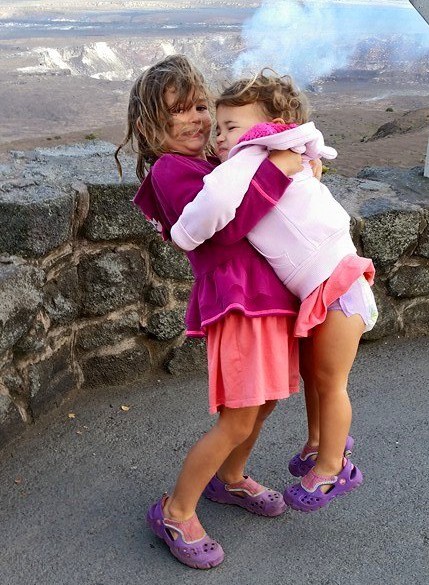
Some of my favorite tiny humans

Lord help us all if one child got more pieces of candy than the others. For my parents, I’m sure managing “justice” was a full-time job. We were extremely vocal is there was even a hint of unfairness in the distribution of sweet goods.

So for parents to think about stepping in the world of social justice can seem daunting. Managing the demands and schedules of tiny humans who at times believe the world revolves completely around them and their Fisher Price toys is a very demanding task.

However.

It is possible.

It is possible to do justice,

to love kindness,

and to walk humbly with your God.

It is possible to raise a generation that is aware of children, women and men that are enslaved in sexual exploitation.

It is possible to create a force of world changers who don’t just care, but also act.

group

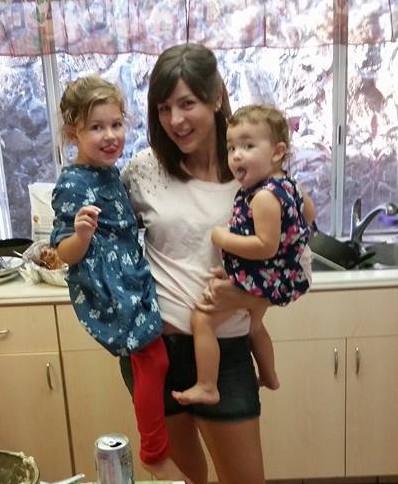
Example of an awesome mom juggling tiny humans! Shout-out to my sister-in-law Kristin

And this doesn’t happen on accident.

This is a word for moms. The mom that can’t imagine adding one more thing to her plate. The mom who can hardly get her child to share her Barbies with the neighbors. The mom who is overwhelmed with getting from one meal and one nap to the next.

Your life and your role is unspeakably important.

And I’d like to introduce a grain of thought that you can live for justice actively with your kids.

But it may look different from the way I live. In fact, it will look different from mine. I’m in a totally different season of life. Your ways will look different, but your impact will also be different, and perhaps greater. In having children, your impact opportunity is exponential. Think of that! It’s not all about how much you accomplish; it’s about multiplying your compassion many times over in your children’s lives.

That’s the kind of math we need in this world.

Moms (and Dads, of course), here’s some things to think about as you approach living an active life seeking justice in your community.

You are not separate from your family.

Whatever you choose to do, do it with your family, with your children. Teach your children about these realities. Don’t hide the realities of human trafficking from them.

Research child trafficking. Read. Watch. Become aware.

Become aware of the realities of child trafficking and prostitution in America and in your very city.

Missing child or runaway report? That child will most likely end up in child prostitution or some form of sexual exploitation.

Foster care and social services? Most of them have gone through some sort of trauma, many of them from sexual and/or physical abuse and are at risk to traffickers and pimps.

As a mother, as a parent, you will have an understanding and anger inside of you that is more direct and empathizing than those without children.

But don’t pursue this out of guilt or revenge; pursue it because you know love and justice are two sides of the same coin.

Allow your heart to melt. Your actions will naturally follow as an overflow of your heart.

And then share with your children. Appropriately, of course, but you can be a good judge of how much they can process at what age.

But whatever you do, don’t hide them from it. Because otherwise we will one day have a generation of sincerely ignorant and insensitive adults who turn their gaze away from really uncomfortable realities that they could actually have an impact in.

Ask your kids what they think you as a family should do to help.

You may be surprised at the amount of creativity and generosity that your kids have. Why not ask and see what they come up with?

This is also about empowerment. If someone feels like they are contributing to a solution, then they will begin to own it for themselves.

Release control of your “perfect house.” Bring broken people in to mess up your perfection.

I’ve noticed an interesting culture of the “perfect-organic-range-free-germ-free home.” The kids can only eat perfectly wholesome food, this is where everything “goes,” schedules cannot be tampered with, and life in general revolves around the total interests of the kids.

And believe me, I know kids thrive and grow under healthy, consistent structure. And, please, someone give them regular naps!

But still, I think there needs to be a safe place where imperfect people can walk in as imperfect and feel accepted.

What if someone “dirty” comes into your home? Will your kids (or you) reject them because they don’t fit into the system?

What if you had a schedule that showed your kids that helping others is more important than playing video games?

What if it was all about “This is simply how we live as a family” instead of “Geez, this is another thing we have to add on top of our already crazy schedule?

For instance…

Our whole family participates in yearly 5k’s to raise awareness about human trafficking.

We go to a local orphanage every Tuesday at 4:00pm and give them cookies we made.

We bring a few kids over from local social services once a week for family game night in our living room.

Every time we give our children allowance, we require that they give 10% of it to raise money to the local safe house for formerly-trafficked girls.

A few more ideas come to mind…

Choose a country that is under the blight of poverty, violence and trafficking. Pray once a week as a family for that country and do research so you can talk about it with knowledge and understanding.

Find an organization that is doing sustainable work in that country, build a relationship, get real names to pray for, and send handmade notes and cards to the ones in the recovery shelters.

Save up and take a vacation as a family to that place as a missions trip.

Overall, it’s about being intentional, being purposeful with your life.

Don’t let life control your life. Teach by example that we can make decisions about what our life practically looks like. We’re not victims of our circumstances or appointments.

If it’s simply a part of your life and values, then you don’t have to worry about “not doing enough” or having to carve out extra time.

But remember, at the end of the day, you are raising a generation of world changers…

So don’t discount the impact you are making to the world by simply being a faithful mom.

We become what we look at. So if your children are spending 18 years of their lives watching your virtues of faithfulness, love, justice, kindness, and generosity, will they not become that themselves?

Start with who you are. Take care of you. Take inventory of your soul.

And then live out loud.

I can’t think of a better way to be a mom of justice than that.

*****

Want to learn about human trafficking and exploitation in America and the world? These are my personal resources.

Here are some the most helpful organizations that I follow on Facebook and use for learning:

Not For Sale

Exodus Cry

International Justice Mission

A21 Campaign

The Abolitionist Movement

Here are organizations that sell really beautiful products that are either made by survivors of trafficking or support them:

WAR Chest Boutique– International free-trade products made by women survivors of trafficking

Bought Beautifully– International free-trade products that support survivors of exploitation

Starfish Project– fair-trade jewelry that employs previously trafficked women in Asia

Colette Sol USA– handmade women’s shoes to fight human trafficking

Cozzee– fair-trade coffee supporting survivors of trafficking

Conferences you seriously need to check out or see if you can stream:

The Justice Conference– Chicago, IL

Abolition Summit– Kansas City, MO

Global Prayer Gathering– Washington, D.C.

Books that have impacted my life and moved me to action:

God in a Brothel– by Daniel Walker. Stories of an undercover investigator’s experiences in saving women and children from sex trafficking around the world.

Possible by Stephan Bauman. A call to reconsider what it means to sustainably impact our neighborhoods, villages, and cities.

Amazing Grace by Eric Metaxas. The story of the remarkable life of the British abolitionist William Wilberforce.

Films that nailed it in showing the realities of trafficking:

Nefarious: Merchant of Souls– award winning documentary on the global sex trade

Demand– documentary that is produced by Shared Hope International and focuses on demand factors for sex trafficking

Dispatches from the Front: Islands on the Edge– documentary highlighting the realities of human trafficking in Southeast Asia

What I Learned From An Ex-Pimp’s Story And How It Relates To The Riots

There’s a soul behind the face.

There’s a heart behind the actions.

There’s a story behind the violence.

I had a major realization a few weeks ago while watching a documentary about sex trafficking in Chicago. The statistics were mind-blowing. I have learned a lot about trafficking, prostitution, and the sex trade in the past few years, but I had no idea how pervasive it was amongst the youth, specifically in Chicago.

childThat the average entry age for prostitution (i.e., trafficking) is 12.

That the average age for boys to start buying sex is 14.

That mothers sell their daughters to drug dealers to pay off debts.

It starts making you really angry at the money-handlers, the dealers.

The pimps.

Behind the face of every child and women trafficked is a pimp that is controlling and dictating every move and action.

The pimps are typically men that are extremely manipulative, controlling, narcissistic, abusive, and greedy. His women are his property, his means of support.

What’s equally mind-blowing is when a pimp leaves that life and is truly a changed person. It’s radical and can be sometimes hard to process. Such an evil person now changed? It’s only possible through life-changing redemption.

Very few pimps leave that life, but I came to hear the story of one.

In a documentary called “Dreamcatchers,” I heard the story of Brenda. She is from South side Chicago and lived in prostitution and trafficking for 25 years. After escaping from that world, she dedicated her life to helping youth and women ensnared in the same world she had been.

In the middle of the film entered a new character, Homer.

Homer, now an ex-pimp, had been the best friend of Brenda’s former pimp. Homer controlled, abused, and sold women just like the rest.

Years later, he changed. Radically. He left behind everything and became an advocate against the street life he used to live, now championing women and the cause of anti-trafficking.

But it wasn’t the incredible life change that grabbed my attention the most.

It was his story, his past.

Homer grew up with a terrible family life. He watched his mother be physically abused by his dad. He knew growing up that this probably wasn’t right, but because his mother never left, he began to believe that this was the way to love. So it was at home that his world-view of people and women evolved.

His dad was always a very angry, resentful man. His dad, now elderly, was actually in the documentary. He was talking with Homer in their home, and his dull, seething anger was incredibly obvious. You could see the dysfunctional home life in real time, though years later.

As Homer talked in an interview later, he described how his father’s anger and home life directly influenced his own life. Homer succumbed to anger and hatred as he himself was physically and sexually abused as a child by people in his life.

With this skewed world-view and mental disorientation, he ran headlong into drugs, alcohol, and sex. It moved naturally into violence, theft, and using prostitutes. As he observed the “benefits” of pimp life, he went full throttle. Women ceased to be people. They were now objects, his property.

Did he ever think that he would be a pimp? “No,” he said. But it was a path, a road that the culture around him gave as an opportunity to find his identity.

But the most telling point of all of this was when the interviewer asked him why he thought his father was so angry and abusive. “Well,” Homer replied, “My father’s father treated him the exact same way.

“I knew my grandfather briefly. He grew up in Alabama and later moved to Chicago. And he was seriously full of anger and wrath. He took it out on his family and was abusive.

“In fact, I believe that if my grandfather had the same opportunity as I did with violence, drugs and pimping, he would have done the same things. He would have been a pimp. He would have been violent in community. I know he would have.”

When I heard this, my mind just froze.

Something clicked. Something I didn’t even wanted to think about or consider.

Perhaps you can’t separate history from hurt.

Perhaps the sins of your fathers could be your sins.

Perhaps…

Perhaps there’s a historical root cause behind all the displays of anger, hatred, abuse, and violence.

Maybe the best way to help Chicago’s violence and trafficking issue dissolve is to help individual people be set free from their anger, which stemmed from pain, which stemmed from a deep wound…

…which may have been injustice.

I believe this ties in directly to all the talk and conversations around race and riots and protests that is getting media attention right now.

And I feel like something needs to be said.

White friends, here’s a word for us: we vastly misunderstand the struggle.

We think, though may not say, that the most violent parts of our cities are where the population is heavily black or minority, so they are the cause of it. It’s just their nature.

And if it’s just their nature, then the solution doesn’t involve our empathy. So we don’t have to feel sorrowful– simply offer pat solutions that gives us the sense we’re involved without actually struggling through the emotional issues with them.

And we act on it.

Sure, maybe not outrightly. That would be hypocritical to our loving, accepting, and religious culture.

But our lives speak louder than words.

Our friends aren’t black (Don’t agree? Scroll through your Facebook friend list right now)

Our churches aren’t diverse (Should not my church reflect the racial percentage of my city or community? Or at least talk about pursuing that?)

Our businesses don’t want to sell to blacks (What I learned from conversations at one of my jobs)

We (might) invite black friends to come into our world instead of us going into theirs.

We make light jokes about, “The war is over. Slavery has been illegal for a long time. That was resolved years ago. You should be over it by now.”

And by say that we’re basically saying, “I don’t care what you feel. You should not feel that. Since I think you should be over it by now, then I don’t have to care about your struggle with it.”

Wait a second, Angela,” you may interject. “You’re saying that the black culture is still hurting from the slavery that was ended after the Civil War way back in 1865?? C’mon…”

I’m saying that I realized that Homer’s great-great-grandfather could have been alive around the time of the Civil War. And the way he could have been unjustly mistreated may have been the seed of anger that grew into abuse. And abuse is proven to pass from generation to generation. Just like it has in Homer’s family.

Yes, I am drawing conclusions and making some assumptions and trying my hardest to understand people’s actions based off their past. And it seems logical, that part of the issue of trafficking I see in Chicago is stemmed from a dysfunctional family life.

Does that give excuses to those that come from dysfunctional families? NEVER! I would never look at the women that Homer prostituted and say, “Well, he was simply a result of his family’s anger which was incited by injustice several generations ago. He shouldn’t be held liable.”

Obviously not. I think you and I both get that.

But I think we need to think a little more before we post and blog and discuss. I think we need to work hard to be intentional about how we diversify our minds, and then our speech, and then our actions.

Guys, it’s really uncomfortable. But get over it. Living this way is meaningful and may not just change you; it could change your community and our entire national culture.

I don’t have any to-do lists for you or how I plan to solve these problems, both of the white misunderstandings or the black realities. I’ve probably offended someone on both sides by making some generalizations.

Yet I believe that dysfunctional can become functional and it can happen in a kind process. Wouldn’t it be great to have someone walk with you through your struggle and say, “I hear for you, I want the best for you, and I empathize with your pain, even if I don’t totally understand it.”

And don’t think I’m really good at this. Do I struggle with discrimination? Have I discriminated before? You bet.

But I’m becoming more aware. More aware of myself, more aware of the struggle, more aware of the past. And being aware makes me fight against my tendencies to only be around people who are just like me and make me feel really comfortable and good about myself.

I think we all need to hear this and ask ourselves the question,

“Am I the one that needs to change?”